



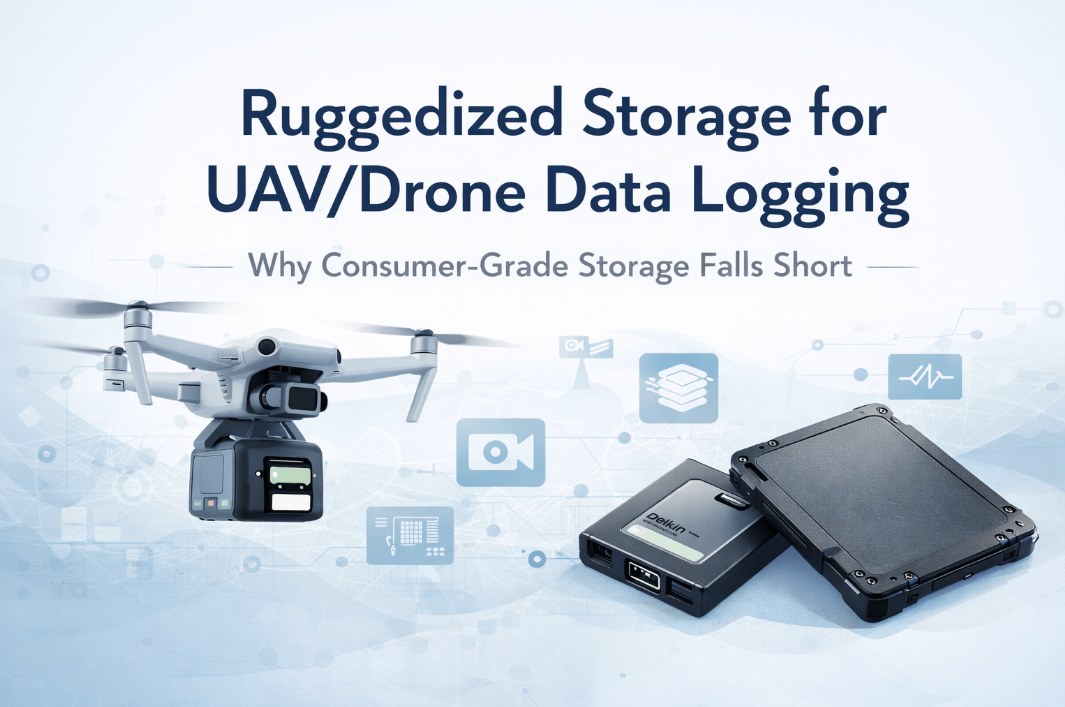
Ruggedized Storage for UAV/Drone Data Logging: Why Consumer-Grade Storage Falls Short
Unmanned aerial vehicles have evolved from novelty gadgets into mission-critical platforms across defense, commercial, and industrial sectors. Modern UAVs capture high-resolution video, multispectral imagery, LiDAR point clouds, and telemetry data, often simultaneously. A single surveillance mission can generate gigabytes of data that must be recorded reliably despite vibration, temperature extremes, and the ever-present risk of hard landings. When that data represents battlefield intelligence, infrastructure inspection records, or agricultural analysis worth thousands of dollars per flight hour, storage reliability is non-negotiable.
Yet many UAV manufacturers and integrators still specify consumer-grade SD cards or SSDs to minimize bill-of-materials costs. This choice often proves costly when drives fail prematurely, corrupt critical mission data, or require frequent replacements, disrupting operations and inflating the total cost of ownership.
The Unique Demands of Airborne Data Logging
UAV operating environments place flash storage under stresses that consumer devices aren’t designed to withstand. Understanding these demands is essential for selecting storage that won’t compromise mission success.
Vibration and shock pose the most immediate physical challenge. Rotor systems, turbulence, and landing impacts impose continuous mechanical stress on storage media. Consumer drives may use components rated for office environments, not the sustained vibration profiles defined in MIL-STD-810 that military and commercial UAVs routinely encounter. A drive that performs flawlessly on a test bench can develop intermittent failures or accelerated wear when exposed to airborne vibration frequencies.
Temperature extremes compound the challenge. UAVs operate on Arctic surveillance missions at -40°C and on desert reconnaissance missions where temperatures can exceed 85°C. High-altitude operations add rapid temperature cycling as aircraft climb through atmospheric layers. Consumer flash storage typically operates from 0°C to 70°C, excluding a significant portion of real-world UAV deployment scenarios. Beyond operational limits, extreme cold degrades NAND cell performance, while excessive heat accelerates wear and can trigger thermal throttling precisely when sustained write speeds matter most.
Power integrity issues create another failure vector. UAV electrical systems experience voltage fluctuations, brownouts during high-current maneuvers, and abrupt power loss during emergency landings or battery failures. Without proper power-loss protection, these events can corrupt file systems, damage flash translation layer tables, or leave drives in unrecoverable states, destroying irreplaceable mission data.
Data Integrity: The Hidden Requirement
Beyond environmental durability, UAV applications require storage that preserves data integrity across extended write cycles and in harsh conditions. Flight data recorders, sensor logs, and telemetry streams serve as legal records for incident investigations, regulatory compliance, and operational accountability. Corrupted or incomplete data can invalidate entire missions and expose organizations to liability.
Consumer storage prioritizes capacity and sequential read speeds, metrics that matter for downloading vacation photos but offer little insight into how a drive handles continuous logging workloads. Industrial flash storage, by contrast, is engineered for sustained random-write performance, deterministic latency, and graceful degradation as NAND cells approach end of life. These characteristics ensure reliable data logging throughout the drive’s service life rather than unpredictable failure.
The True Cost of Consumer-Grade Compromise
The initial price difference between consumer and industrial flash storage often leads procurement teams to specify consumer drives. This calculation typically ignores the downstream costs that accumulate over a UAV platform’s operational life.
Consumers frequently change internal components- NAND dies, controllers, and firmware without notice or changes to part numbers. A drive that passed platform qualification may ship six months later with entirely different internals that behave differently under stress. These silent changes can introduce compatibility issues, performance variations, or premature failures, requiring costly requalification cycles or field replacements.
Failed missions represent another hidden cost. When a storage failure corrupts survey data, surveillance footage, or inspection records, the lost flight time, fuel, and operator hours often exceed the cost difference between consumer and industrial storage by a wide margin. For defense applications, data loss can compromise operational security or destroy critical intelligence.
Why Delkin Industrial Flash Delivers for UAV Applications
Delkin has supported aerospace and defense customers for nearly four decades, developing flash storage engineered to meet the demands of airborne platforms. Our industrial SD cards, microSD cards, and embedded storage solutions address the unique challenges faced by UAV integrators.
Extended temperature ranges from -40°C to +85°C ensure reliable operation across the full spectrum of UAV deployment environments. Our products undergo environmental screening and are tested to MIL-STD-810 shock and vibration profiles, thereby validating performance under the mechanical stresses that airborne systems encounter daily.
Delkin’s locked bill-of-materials policy guarantees that the storage you qualify for today performs identically throughout your platform’s production life. We don’t silently substitute components. When NAND transitions are necessary, we provide advance notice and engineering support to minimize the requalification burden.
Power-loss protection features safeguard data integrity during the voltage anomalies common in UAV electrical systems. Our firmware is optimized for continuous workloads, ensuring consistent logging performance rather than the burst-oriented optimization typical of consumer drives.
All Delkin industrial products are designed and assembled at our California headquarters, providing full component traceability and U.S.-based engineering support. For defense contractors requiring domestic sourcing or ITAR compliance, this approach reduces supply chain complexity and supports security requirements.
Selecting Storage That Matches Your Mission
As UAV platforms grow more sophisticated and mission data more valuable, storage selection deserves the same engineering rigor as sensors, flight controllers, and communication systems. The few dollars saved on consumer-grade storage can lead to failed missions, lost data, and operational disruptions that far outweigh any initial savings.
Delkin’s engineering team works directly with UAV integrators to match storage specifications to application requirements, whether that means high-endurance SLC flash for continuous flight data recording, extended-temperature microSD for small tactical platforms, or custom configurations for specialized sensor payloads.
Contact Delkin today to discuss your UAV storage needs and learn how ruggedized industrial flash can improve your platform’s reliability and mission success.